
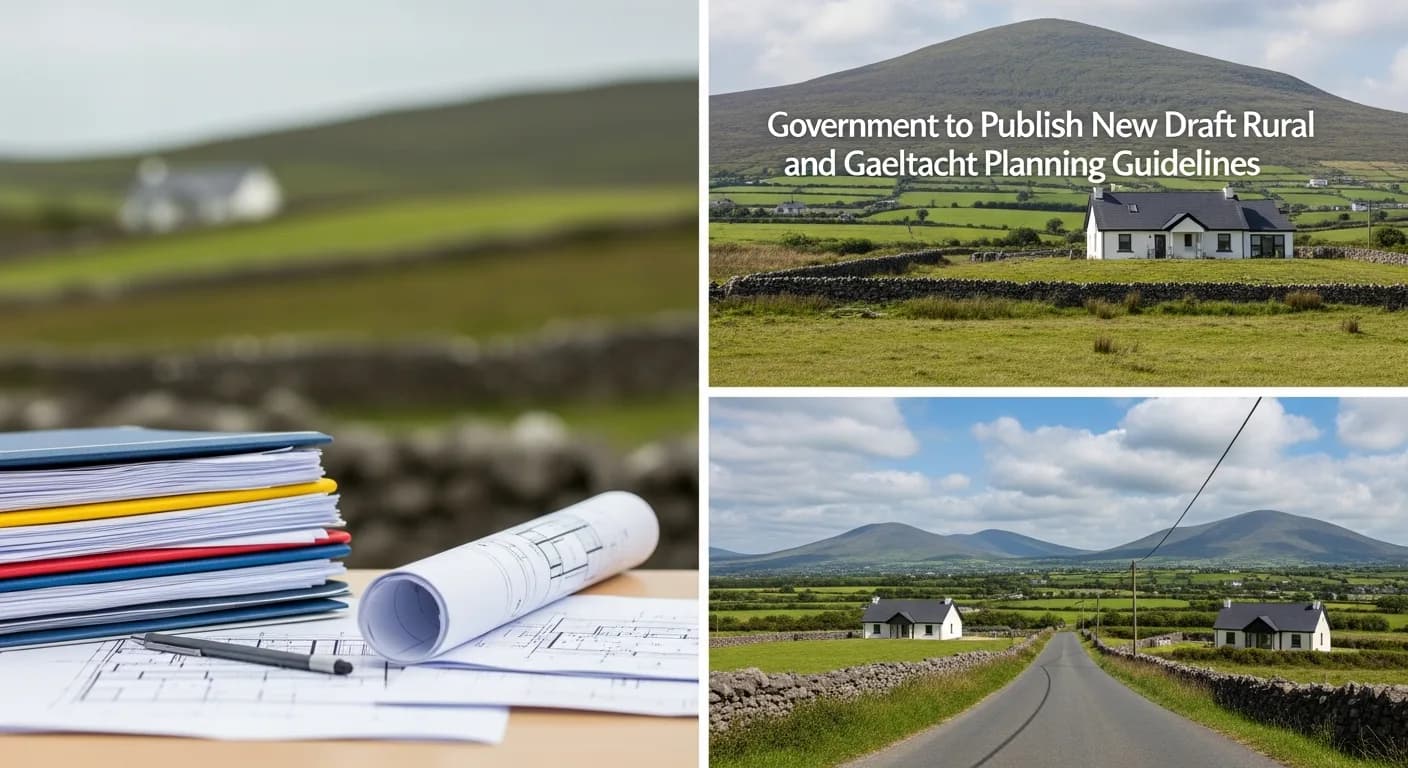
Government to Publish New Draft Rural and Gaeltacht Planning Guidelines
Tuesday 30 June 2026
The Irish government is releasing new draft planning guidelines for rural and Gaeltacht housing, aimed at relaxing restrictions on one-off builds and expanding qualifying criteria.
The Irish government is publishing new draft planning guidelines for rural and Gaeltacht housing to ease restrictions on building one-off homes.
The draft guidelines introduce significant changes to how planning applications are evaluated in rural Ireland. Under the new proposals, the "economic need" category will be expanded to include essential rural workers such as teachers, equine industry staff, and forestry workers. However, remote workers are excluded from this specific classification.
Local Need and Residency Rules
To qualify under "local need" criteria, applicants must demonstrate they have lived in the area for ten years. For Irish speakers applying for homes in Gaeltacht areas, this residency requirement is lowered to five years.
The guidelines also relax local connection rules for urban dwellers, allowing individuals currently residing in towns or cities to qualify if they can prove a clear need for rural housing.
Once a home is built under these provisions, it must serve as the applicant's principal private residence for a minimum of ten years. Property owners are prohibited from listing these homes as short-term rentals during this ten-year period.
Standardising Local Authority Rules
The draft guidelines target specific restrictions currently imposed by local councils. Local authorities will be prevented from using minimum road frontage requirements or "no more than five houses in a row" rules to block infill or ribbon developments.
These updated guidelines are expected to come into effect later in 2026. A National Planning Statement will also be published to establish uniform criteria across all local authorities, aligning local policies with the National Planning Framework.