
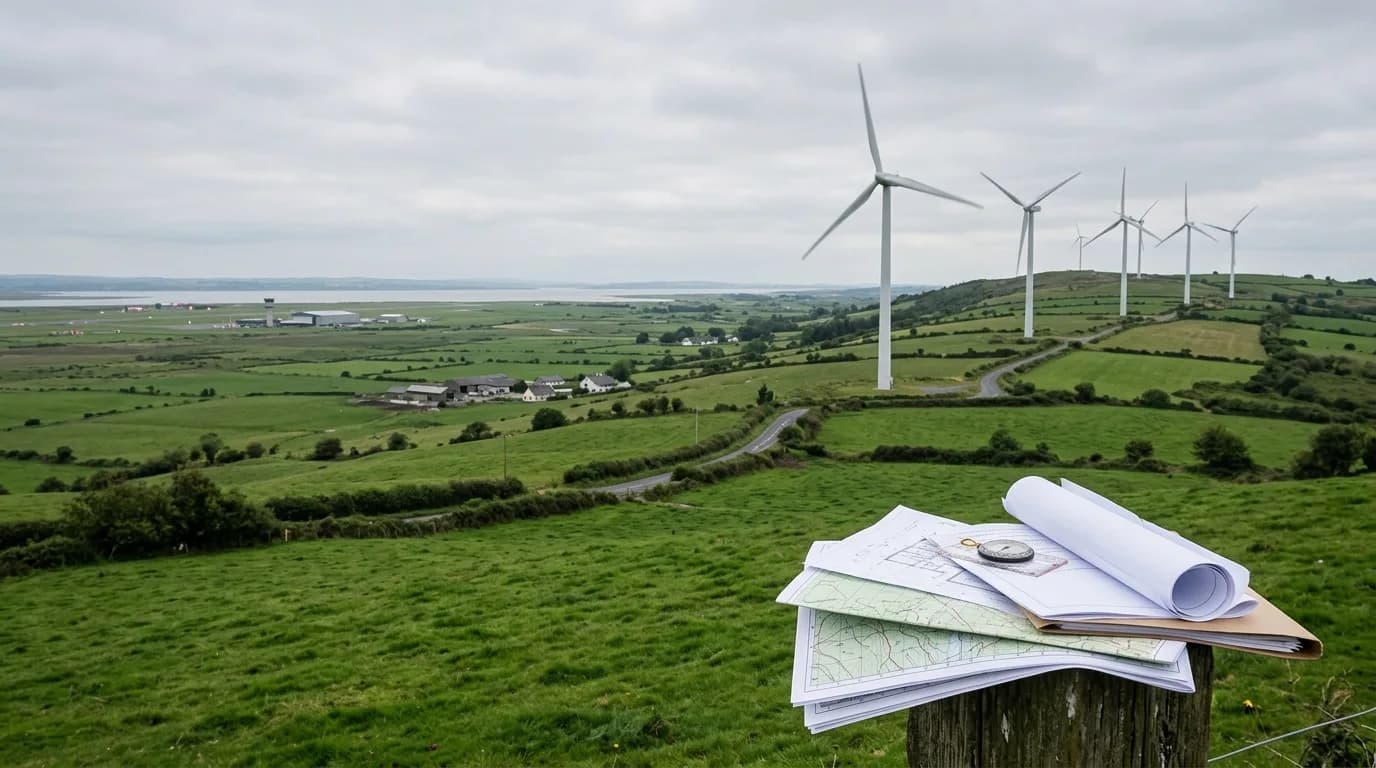
AirNav Assessments Warn East Clare Wind Farms Could Threaten Shannon Airport Landing Capability
Thursday 19 November 2026
A Dáil debate heard that AirNav Ireland assessments show approved wind farms in east Clare could jeopardise Shannon Airport's Category II low-visibility landing capabilities.
Assessments by AirNav Ireland indicate approved east Clare wind farms could compromise Shannon Airport's low-visibility landing capability, a Dáil debate has heard.
Raising the matter during a Topical Issue debate, Deputy Cathal Crowe highlighted that three wind energy projects in east Clare—at Carrownagowan, Fahy Beg, and Lackareagh—have secured planning permission. A further three proposals at Oatfield, Ballycar, and Knockshanvo have live applications pending in the planning system.
According to Deputy Crowe, AirNav Ireland assessments indicate that if any of the three permitted wind farms proceed, Shannon Airport could potentially lose its Category II (CAT II) capability. CAT II instrument capability authorises aircraft to land safely during poor weather conditions involving fog, low cloud, or heavy rain.
Without this operational standard, incoming flights would face diversions while departures could see cancellations. Crowe emphasised Shannon's critical role as the State's primary diversion aerodrome, noting it accommodated 357 diverted aircraft carrying more than 39,000 passengers over the past five years, along with 185 Air Corps movements in 2025.
Responding, Minister of State John Cummins confirmed that aerodrome safeguarding seeks to prevent nearby developments from adversely affecting aerodromes and surrounding airspace. Cummins acknowledged that wind turbines can cause physical obstructions, radar clutter, or technical interference with communications, navigation, and surveillance systems, alongside potential cumulative effects from multiple projects.
Cummins stated that the Department of Housing, Local Government and Heritage recognises the balance required between national renewable energy targets and aviation safety. He noted that conflicts concerning individual planning proposals should be resolved through early stakeholder engagement, robust technical evidence, and agreed mitigation where feasible.