
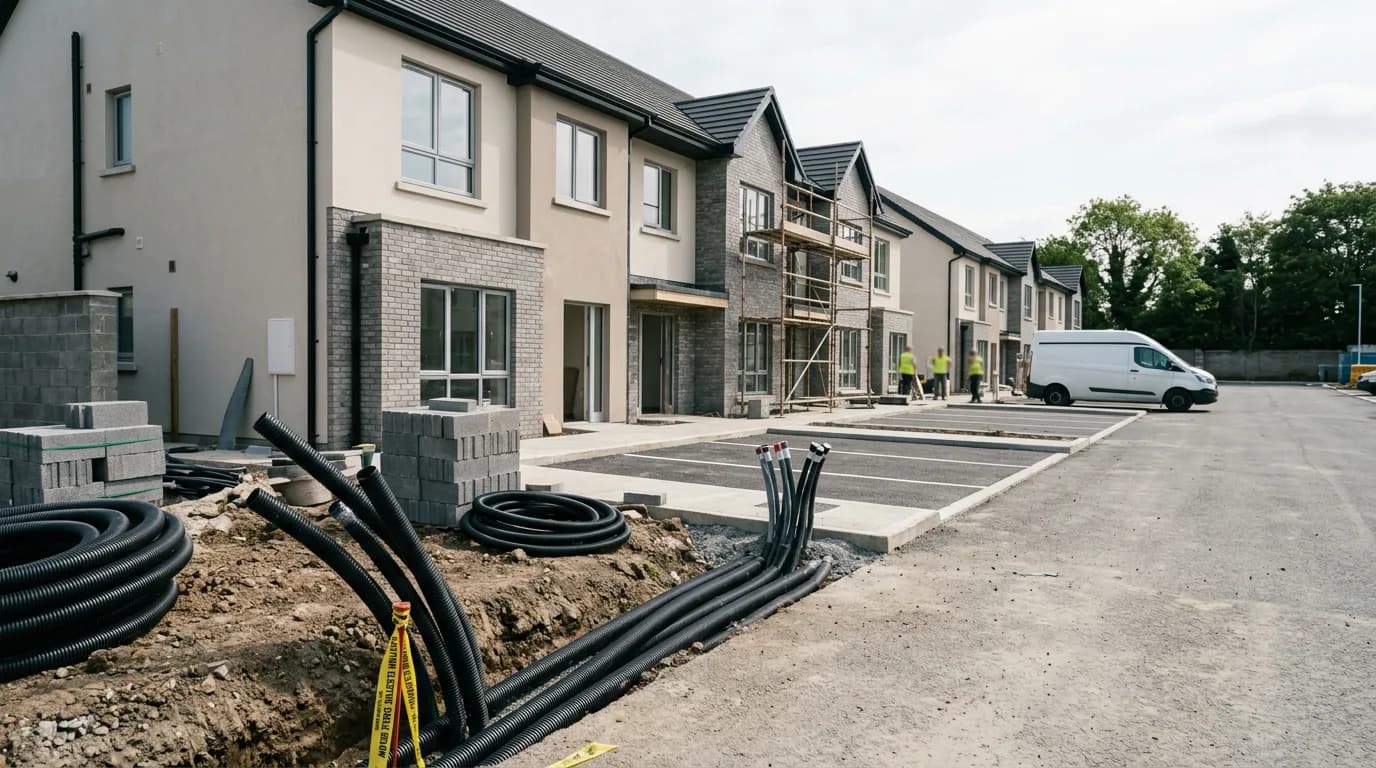
Dáil Debate Clarifies Planning Enforcement Role in Multi-Unit EV Charging Ducting
Thursday 5 November 2026
Planning authorities are responsible for enforcement where developers fail to install planning-mandated EV charging ducting in residential developments, the Dáil has heard.
Local planning authorities are responsible for taking enforcement action if developers fail to install electric vehicle charging ducting required by planning permissions, Minister of State Kieran O'Donnell confirmed in the Dáil.
The issue was raised by Deputy Louise O'Reilly during a Topical Issue debate concerning residents in multi-unit developments who cannot install home electric vehicle (EV) chargers.
Deputy O'Reilly highlighted cases where planning permission required ducting to every parking space, but buyers later discovered no conduits were installed. She also raised difficulties in estates with communal parking bays where local authorities provide no mechanism to allow charging cables across public footpaths.
In response, Minister of State at the Department of Housing, Local Government and Heritage Kieran O'Donnell stated that planning permissions may specify parking layouts and EV charging provisions. He confirmed that where non-compliance with a grant of planning permission is reported, it is for the relevant planning authority to consider enforcement action.
He added that mandatory EV charging requirements are primarily set through building regulations. Under S.I. No. 535/2022 (Building Regulations (Part L Amendment) Regulations 2022), which applies to works commencing on or after 1 November 2022, new multi-unit residential buildings or those undergoing major renovation must install ducting infrastructure for each parking space located inside or within the curtilage of the building.