
Choose Your Foundation — Your Engineer Picks, Your Soil Decides, Your Budget Pays
On this page
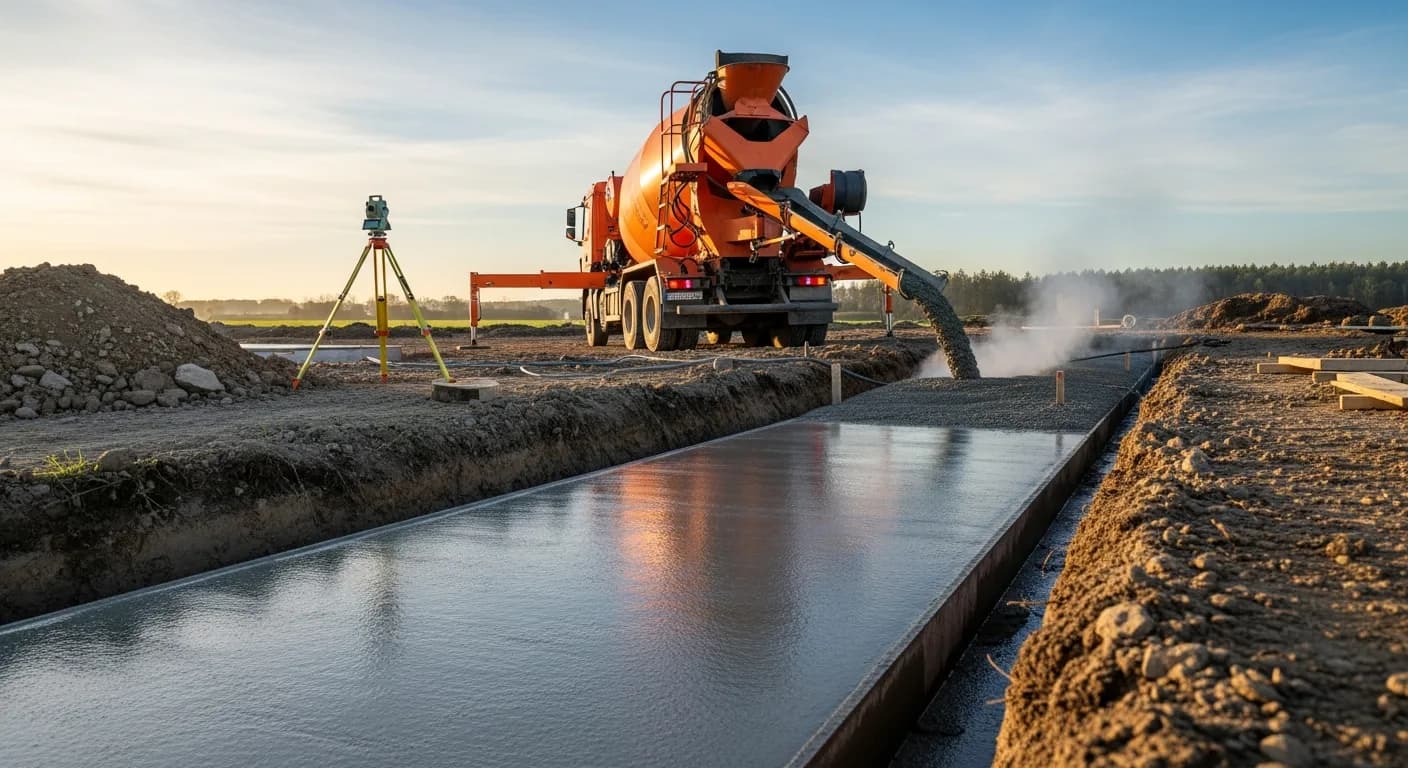
Strip on good soil: €120–€180/m². Raft on clay: €180–€260/m². Piled on peat: €280–€450/m².
When this matters most
You're at detailed design and need to commit to a foundation type. Or you're existing stock and considering subfloor replacement.
When this doesn't apply
Foundation is already poured and cured. You're in stages 6+ of this site.
Sources
Building Regulations 2023, Technical Guidance Document A (Structure), Department of Housing. https://www.gov.ie/
Irish Geological Survey, Irish Soil Classification System. https://www.gsi.ie/
Your options at a glance
Strip foundation
Concrete strip under load-bearing walls. The cheapest option, but only works where the soil is competent (rock, gravel, dense sand) and the load is moderate.
- Cost
- €120–€180/m² footprint
- Soil needed
- Class 1–2 (rock, gravel, dense sand)
- Build time
- 1–2 weeks
- Best for
- Standard 1–2 storey on good ground
- Engineer-led?
- Yes — depth and width are calculated
Raft foundation
A single reinforced concrete slab that floats on prepared ground. Distributes the load across the whole footprint. The all-rounder — works on most Irish soils.
- Cost
- €180–€260/m²
- Soil needed
- Class 3–4 (firm clay, silt, sand with clay)
- Build time
- 2–3 weeks
- Best for
- Most Irish self-builds — clay sites, mixed ground
- Engineer-led?
- Yes — design depends on soil report
Piled raft / driven piles
Concrete piles driven or bored deep into competent strata, with a raft slab on top. The answer when surface soil won't carry the building.
- Cost
- €280–€450/m²
- Soil needed
- Class 5+ (peat, soft clay, made ground, fill)
- Build time
- 4–6 weeks (piling takes 1–3 weeks on its own)
- Best for
- Boggy ground, reclaimed land, variable fill
- Engineer-led?
- Yes — and the piling contractor specifies
Quick decision matrix
| If your situation is | Then choose |
|---|---|
| Soil is Class 1–2 (rock, gravel, dense sand) | Strip foundation. €120–€180/m² footprint. |
| Soil is Class 3–4 (firm clay, silt, sand with clay) | Raft foundation. €180–€260/m². |
| Soil is Class 5+ (peat, soft clay, made ground, fill) | Piled raft or driven piles. €280–€450/m². |
| Site is sloped >2 m across footprint | Stepped strip or raft with retaining. +€40–€80/m². |
| Site has a high water table | Raft with water management + tanking. +€30–€60/m². |
| Radon is high (Co. Carlow, Wexford) | Add radon barrier and sump. +€8–€15/m². |
Frequently asked questions
How much does a foundation cost per m² in Ireland?
€120–€450/m² of footprint depending on soil class. A 150 m² house on a strip foundation = €18,000–€27,000; piled raft on the same footprint = €42,000–€67,500.
Do I really need a soil test?
Yes. Without it your engineer is guessing, and you're carrying the risk. €1,500–€3,000 for the test can save €30,000–€60,000 in over-spec'd or under-spec'd foundations.
What is a raft foundation?
A reinforced concrete slab that spreads the building load across the entire footprint. Cheaper than piling for moderate soils; faster than strip+wall for variable soils. Most BER A1 self-builds use raft because of subfloor insulation integration.
What is a piled raft?
Piles driven or bored to firm bearing strata, then a reinforced concrete slab capping them. Required when soil near the surface cannot support the building.
Do I need a radon barrier?
Yes, on every new build in Ireland since 1998. Most are a 1,200-gauge polythene membrane. In high-radon areas (Carlow, Wexford) add a radon sump and extract fan.
When this matters most
You're at detailed design and need to commit to a foundation type. Or you're existing stock and considering subfloor replacement.
When this doesn't apply
Foundation is already poured and cured. You're in stages 6+ of this site.
Briefs in this stage
10 in-depth answers for this stage of the build. Pick the one that matches your question.

Foundation Cost by Soil Class in Ireland — The €/m² by Class 1 to Class 5+
Class 1–2: €120–€180. Class 3–4: €180–€260. Class 5+: €280–€450. Plus €30–€80 for slope and water-table adds.
foundation cost by soil class IrelandRead brief →
Foundation Depth in Ireland — 900 mm, 1.2 m, or Below Frost Line
Frost line in Ireland is 600–900 mm. Most foundations go 900 mm–1.2 m. Engineer specifies based on soil class and load.
foundation depth IrelandRead brief →
Foundation Gotchas in Ireland — The Six Things That Catch Self-Builders Off Guard
Skip the soil test, ignore the radon, undercut the edge insulation, assume the slope is OK — six mistakes, six €10k+ fixes.
foundation gotchas IrelandRead brief →
Foundation for a Timber Frame House in Ireland — Raft Is the Standard
Timber frame walls are lighter than block, so a raft is usually the right foundation. Engineer specifies the slab edge detail.
foundation for timber frame IrelandRead brief →
Piled Raft Foundation in Ireland — For Peat, Made Ground, and Soft Clay Sites
Piled raft on Class 5+ ground: €280–€450/m². Piles transfer the load to a firm bearing stratum below the poor soil.
piled raft IrelandRead brief →
Radon Barrier in Ireland — Where It's Needed, What It Costs, and the Carlow-Wexford High-Risk Map
Radon barrier mandatory on every new build in Ireland since 1998. €8–€15/m² footprint. Carlow, Wexford, parts of Wicklow: add a sump.
radon barrier IrelandRead brief →
Raft Foundation in Ireland — The All-Rounder for Class 3–4 Ground and Subfloor Insulation
Raft on Class 3–4: €180–€260/m². Spreads the load across the whole footprint. Cheapest path to a high-performing subfloor.
raft foundation IrelandRead brief →
Strip Foundation in Ireland — When It Works, What It Costs, and What the Engineer Will Check
Strip on good soil: €120–€180/m² of footprint. Cheapest foundation. Class 1–2 ground only.
strip foundation IrelandRead brief →
Subfloor Insulation in Ireland — PIR, EPS, or Mineral Wool, and What Part L 2022 Demands
Floor U-value 0.13 W/m²K is the Part L 2022 backstop. 100–150 mm PIR or 200 mm EPS achieves it. Don't skimp on the edges.
subfloor insulation IrelandRead brief →
Suspended vs Solid Floor in Ireland — Timber Suspended, Solid Slab, or Beam-and-Block
Solid slab (raft) is the standard for most Irish self-builds. Suspended timber or beam-and-block for difficult sites.
suspended vs solid floor IrelandRead brief →
Where to go next
Next decision
The next step in your build sequence.
- Foundation Depth in Ireland — 900 mm, 1.2 m, or Below Frost Line →
- Foundation for a Timber Frame House in Ireland — Raft Is the Standard →
- Piled Raft Foundation in Ireland — For Peat, Made Ground, and Soft Clay Sites →
- Raft Foundation in Ireland — The All-Rounder for Class 3–4 Ground and Subfloor Insulation →
- Subfloor Insulation in Ireland — PIR, EPS, or Mineral Wool, and What Part L 2022 Demands →
Branch into
Adjacent decisions at the same stage.
Watch out for
Common mistakes, hidden costs, gotchas.
- Foundation Cost by Soil Class in Ireland — The €/m² by Class 1 to Class 5+ →
- Foundation Gotchas in Ireland — The Six Things That Catch Self-Builders Off Guard →
- Radon Barrier in Ireland — Where It's Needed, What It Costs, and the Carlow-Wexford High-Risk Map →
- Strip Foundation in Ireland — When It Works, What It Costs, and What the Engineer Will Check →
Compare with
Alternative approaches worth knowing.